

Table of Contents
ToggleHotel SEO That Doubled Bookings: Lessons from a Motel in Salida, Colorado
Salida, Colorado is not a place most people outside the state think about when they plan a trip to the Rockies. Vail, Aspen, Breckenridge — these are the names that dominate the conversation. But among outdoor enthusiasts, whitewater rafters, mountain bikers, and people who want a genuine Colorado experience without the crowds and prices of the ski resort towns, Salida has become one of the most sought-after destinations in the state.
The Arkansas River running through Salida offers some of the best whitewater rafting in North America. The Monarch Mountain ski area is minutes away. The town’s arts district and Victorian-era downtown draw visitors year-round. Tourism in Salida has been growing steadily — and with it, demand for accommodation.
The motel we worked with was well-positioned in the middle of all of this. Good location. Clean, well-maintained rooms. Competitive pricing. A property that guests who stayed there genuinely liked.
And yet: bookings were not where they should have been for a property in one of Colorado’s rising tourism destinations.
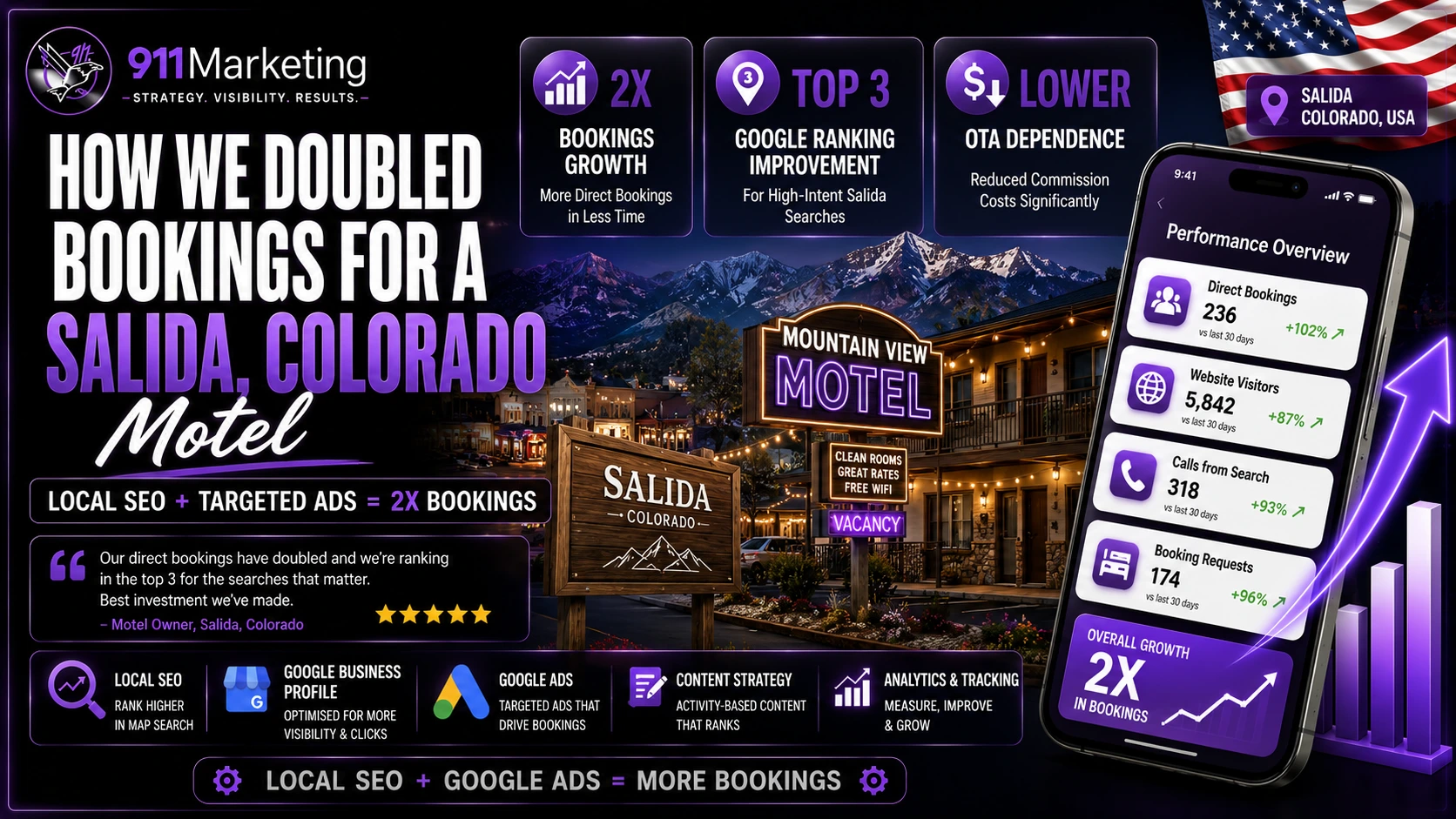
By the time our engagement was complete, bookings had doubled and the property’s Google ranking had improved significantly across the search terms that actually drive travellers to book. This is how we got there.
Why Salida is a hospitality opportunity most people miss
Understanding the Salida market is essential to understanding why the strategy worked the way it did. This was not a generic hotel marketing project — the context shaped every decision.
Salida sits in the Upper Arkansas River Valley at an elevation of around 7,000 feet. It has a permanent population of roughly 5,000, but its visitor numbers in peak season are multiples of that. The town has been consistently ranked among Colorado’s best small towns and has attracted a growing community of outdoor enthusiasts, artists, remote workers, and retirees.
What this means for hospitality marketing is that the search intent profile is specific and rich. People searching for accommodation in Salida are not typing “hotel Colorado” — they are typing things like:
- “motels in Salida CO”
- “where to stay for rafting on the Arkansas River”
- “accommodation near Monarch Mountain Colorado”
- “pet-friendly hotels Salida Colorado”
- “cheap places to stay Salida CO”
These are long-tail, high-intent search terms with relatively low competition — exactly the kind of keyword landscape where a well-optimised independent property can rank above OTA listings and national chains if the local SEO groundwork is done properly.
The problem: a good motel in a growing town that nobody could find
When we began the engagement, the motel’s digital situation was one we recognise immediately — not because it is unusual, but because it is the default state of most independent accommodation providers in the United States.
The property had a website. It had a Google Business listing. It was listed on Booking.com and Expedia. On the surface, it appeared to have a digital presence. In reality, that presence was barely functioning.
The website was not optimised for any of the specific search terms that Salida travellers actually use. The Google Business Profile had not been actively managed — few recent photos, minimal service information, and a review count that did not reflect the actual volume of guests who had stayed and been satisfied. The OTA listings were the primary booking channel, which meant the motel was paying commission on every booking that could have come in directly.
And critically: the motel was invisible for the activity-based and experience-based search terms that drive the majority of Salida travel decisions. Nobody searching “where to stay for Monarch Mountain skiing” was finding this property. Nobody searching “motel near Arkansas River rafting” was being directed to it. The guests who were booking were either returning visitors who already knew the property, or travellers who happened to find it on an OTA and chose it on price.
That is a fragile and expensive way to run a hospitality business.
What the audit revealed
The rapid audit we conducted before building the strategy identified four specific problem areas:
Sparse listing. Photos outdated. No posts in months. Service attributes incomplete. Review responses absent — a signal to both Google and potential guests that the property was not actively managed.
No location-specific page titles or meta descriptions. Zero activity-based content. No pages targeting the search terms Salida travellers actually use. The site was essentially invisible to Google for any search beyond the motel’s own name.
Over 70% of bookings were coming through OTA platforms, with commission rates of 15–20% per booking. The motel had no direct booking system that was generating meaningful traffic or converting at a competitive rate.
No Google Ads. No local search advertising. When travellers searched for Salida accommodation, the motel had no paid presence to complement its weak organic position — meaning it was invisible at both levels simultaneously.
The strategy: local SEO + targeted ads
The strategy was built around two parallel objectives: improve organic visibility through local SEO so the motel would rank consistently for Salida accommodation searches, and create immediate paid visibility through Google Ads to capture bookings while the organic work matured.
Google Business Profile rebuild
We treated the GBP as the highest-priority asset. Complete category and attribute review — adding relevant attributes like “pet-friendly,” “free parking,” and “outdoor access.” A full photo upload covering rooms, exterior, the view, and the surrounding landscape. A rewritten business description that named Salida, the Arkansas River, Monarch Mountain, and the town’s key activities. Regular posts — at least two per week — covering seasonal events, local activities, and booking prompts. A systematic review management process: every guest who checked out received a follow-up request. Within eight weeks, the review count had more than doubled and the average rating had strengthened. Google responded with improved map pack placement.
Activity-based SEO content on the website
We added dedicated pages targeting the specific activity and experience searches that drive Salida travel decisions. A page for rafting visitors: “Staying in Salida for the Arkansas River — Where to Base Yourself.” A page for winter visitors: “Accommodation Near Monarch Mountain — Ski and Stay in Salida.” A page for the general visitor: “Things to Do in Salida, Colorado — And Where to Stay.” Each page was written to answer the genuine questions a traveller planning a Salida trip would have — not keyword-stuffed filler, but useful, specific content that positioned the motel as the natural accommodation choice for each activity. These pages also internally linked to the direct booking page, shortening the path from discovery to reservation.
Google Ads for immediate booking capture
While the SEO work built organic rankings over weeks and months, Google Ads provided immediate visibility for the search terms that mattered most. We ran a tightly structured campaign across three ad groups: direct accommodation searches (“motels Salida CO,” “places to stay Salida Colorado”), activity-adjacent searches (“accommodation near Arkansas River rafting,” “stay near Monarch Mountain”), and competitive terms to ensure the motel appeared when travellers were comparing Salida options. Ad copy was written to speak directly to the Salida traveller — referencing outdoor activities, the location, and the value proposition of a direct booking versus an OTA. The campaign ran on a modest daily budget and generated consistent, measurable direct bookings from the first week.
Review velocity programme
Reviews are one of the most influential ranking factors for local accommodation searches — and one of the most neglected. We built a simple, low-friction system: a QR code at checkout linking directly to the Google review page, a follow-up text message sent 24 hours after departure, and a response template ensuring every review — positive or negative — received a timely, personalised reply. A property that actively manages its reviews signals to Google that it is a credible, active business. It also converts undecided travellers who are comparing properties on Google Maps. Both effects contributed to the booking growth.
The OTA dependency problem — and how we addressed it
This deserves its own section because it is one of the most important structural issues facing independent accommodation providers in the United States today.
OTA platforms — Booking.com, Expedia, Hotels.com, Airbnb — are powerful distribution channels. They reach travellers who would not otherwise find an independent property. Used correctly, they are a legitimate part of a hospitality business’s booking mix.
The problem arises when they become the primary channel — when 70% or more of your bookings are coming through platforms that charge 15–25% commission per reservation. At that level of dependence, you are effectively running a hotel on behalf of a technology company. The margin erosion is significant, and the property has no direct relationship with the traveller, no ability to market to them after checkout, and no control over how the property is presented relative to competitors.
The goal of the SEO and Google Ads strategy was not to eliminate OTA bookings — it was to rebalance the channel mix so that a meaningful proportion of bookings came in directly. Every direct booking that replaces an OTA booking recovers 15–25% margin. At scale, that is the difference between a comfortable and a marginal hospitality business.
The direct booking math: If a motel generates 100 bookings per month at an average rate of $120 per night, and 70 of those come through OTAs at 18% commission, the commission cost is $1,512 per month. Shifting 30 of those to direct bookings — which is a realistic outcome from a focused SEO and Google Ads strategy — recovers approximately $648 per month in pure margin. That is $7,776 per year recovered from a single channel shift.
The results
| Metric | Before | After |
|---|---|---|
| Monthly bookings (total) | Baseline | 2× baseline (doubled) |
| Google Maps ranking (primary accommodation searches) | Outside top 10 | Consistent top 3 |
| Google reviews | Low count, infrequent | Doubled, average rating improved |
| Direct website bookings (monthly) | Minimal | Meaningful increase, measurable via Google Ads tracking |
| OTA booking share | ~70%+ of total | Reduced — direct channel share increased |
| Activity-based keyword rankings | Not ranking | First page for multiple Salida activity + stay terms |
What independent hotel and motel owners can apply right now
The Salida case study contains lessons that apply to any independent accommodation provider in the United States — regardless of location, size, or budget. These are the highest-leverage actions:
- Audit your Google Business Profile today. Check that your categories, attributes, photos, hours, and description are complete and current. If you have not posted in the last 30 days, that is a gap. If you have not responded to your most recent reviews, that is a gap. Fix both immediately — it costs nothing and the impact on local rankings is direct.
- Create pages for the activities your guests come to do. Your guests are not searching for your motel by name — they are searching for experiences. Meet them at that search with content that answers their question and naturally introduces your property as the place to stay.
- Build a review system that runs automatically. A QR code on the checkout receipt and a 24-hour follow-up text takes less than an afternoon to set up and compounds indefinitely. Consistent review volume is one of the most durable ranking signals in local search.
- Run Google Ads while your SEO matures. SEO takes 8–12 weeks to produce strong organic rankings. Google Ads can put you in front of the right travellers tomorrow. Run both in parallel — the ads generate bookings while the organic work builds the foundation.
- Measure your OTA dependence and set a target to reduce it. If more than 50% of your bookings are coming through OTA platforms, you have a vulnerability and a margin problem. A direct booking channel, built through SEO and Google Ads, is the most sustainable fix.
- Respond to every Google review — positive and negative. A thoughtful response to a critical review is often more persuasive to prospective guests than the negative review itself. It demonstrates that the property is managed by people who care. Google also rewards active review management with improved local visibility.
Frequently asked questions
How can a small hotel or motel increase bookings using digital marketing?
The most effective combination for independent properties is Local SEO to rank on Google Maps, Google Ads to capture high-intent travellers who are actively searching for accommodation in the area, an optimised Google Business Profile with strong and recent reviews, and activity-based content on the website that meets travellers at the point of their trip planning search. Used together, these channels can produce meaningful booking growth within 60–90 days.
Is SEO worth it for a small motel or independent hotel?
Yes — and often more so than for large chains. National hotel brands compete on branded terms and OTA placement. Independent properties can dominate local and activity-based search terms that chains and OTAs rarely optimise for. A well-executed local SEO strategy for an independent motel is one of the most cost-effective marketing investments available, because the traffic it generates is ongoing and commission-free.
How do I reduce my hotel’s dependence on OTA platforms?
The most reliable path is building direct booking traffic through SEO and Google Ads. When travellers find your property directly on Google — either through organic results or paid ads — they book directly, and you keep the commission margin. Pair this with a smooth direct booking experience on your website and a clear reason to book direct (a small rate advantage, a free amenity, flexible cancellation) and the channel shift accelerates.
Does 911Marketing work with hotels and motels across the USA?
Yes. We work with independent accommodation providers across the United States, including the Salida, Colorado property featured in this case study. Our hospitality marketing work covers Local SEO, Google Ads, Google Business Profile management, review strategy, and direct booking optimisation. If you would like to discuss what a comparable engagement could look like for your property, reach out using the link below.