
Table of Contents
ToggleDigital Marketing for Restaurants in Nashville — What Actually Works in 2026
Nashville is one of the most exciting restaurant cities in the United States right now — and one of the most unforgiving for independent operators who are not visible online. Fourteen million tourists visit Nashville every year. The city has added thousands of new residents over the past decade. New restaurants open every month. And the digital channels that diners use to decide where to eat — Google, Instagram, Yelp — are more competitive than they have ever been.
If your restaurant is not showing up where Nashville diners and visitors are looking, you are not competing. You are hoping.
This guide covers the exact digital marketing strategy that works for Nashville restaurants in 2026 — not generic advice, but specific, sequenced tactics based on what 911Marketing has delivered for restaurant clients across the US and UK. We will cover what is worth your time and money, what is not, and the common mistakes that are costing Nashville restaurant owners covers they should already be filling.
What makes Nashville’s restaurant market different
Before building any marketing strategy, it helps to understand what is specific about Nashville’s diner profile — because the city is genuinely unusual in ways that affect which channels matter most and how campaigns should be structured.
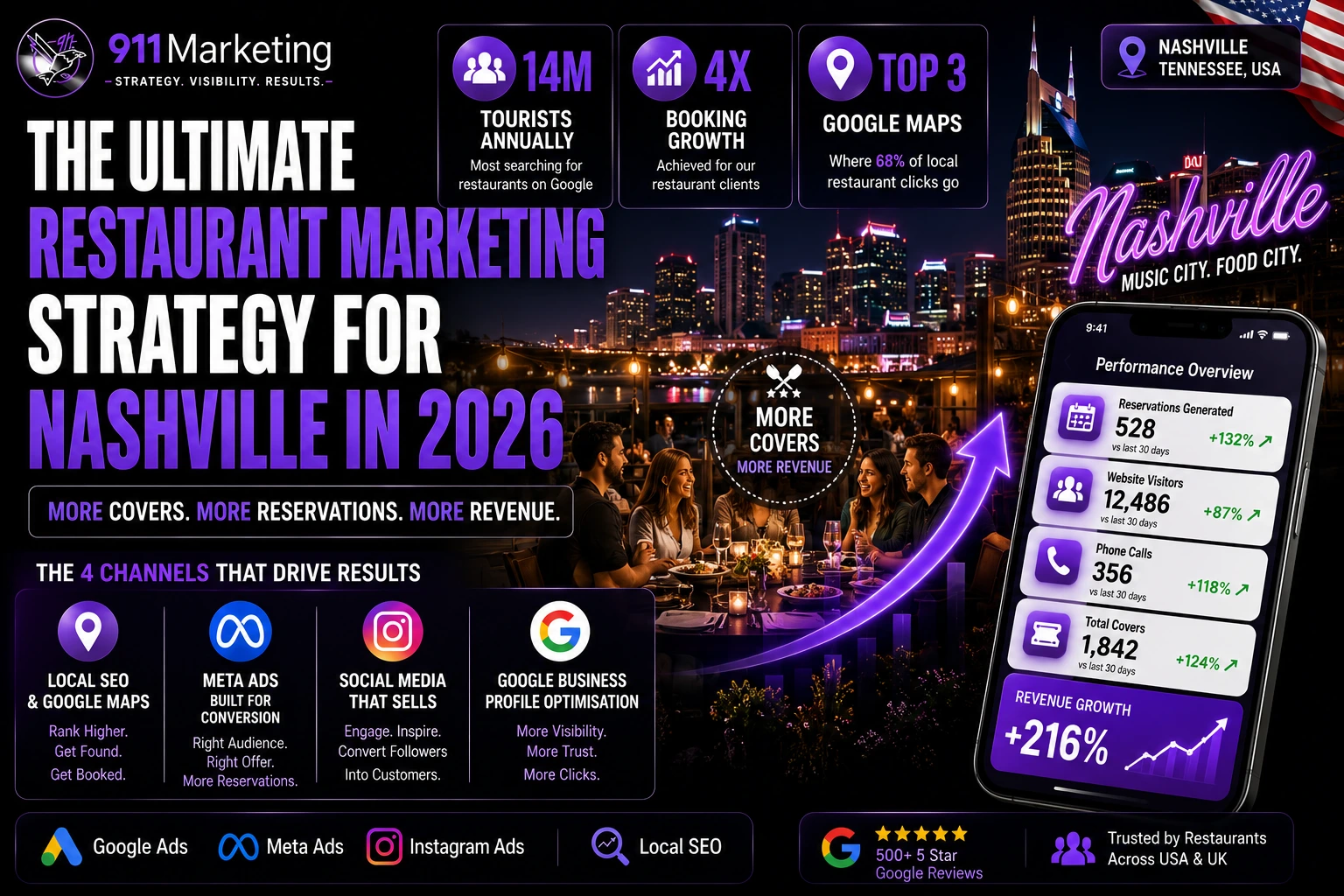
Nashville sees 14 million visitors per year, with strong concentrations around Broadway, The Gulch, East Nashville, and 12 South. These visitors are actively searching Google for dining options in real time — often on mobile, often within hours of their meal. They are high-intent and time-compressed.
Nashville is the top bachelorette party destination in the United States. These groups plan weeks or months in advance, rely heavily on Instagram and Google reviews, and book large-party reservations. Restaurants that appear in their research phase win the booking.
Nashville’s population has grown by over 100 people per day for the past decade. New residents actively explore the city’s dining scene. Neighbourhood-specific searches — “best restaurants East Nashville,” “brunch Germantown” — are consistently high volume and underserved by many independent restaurants.
New restaurants open in Nashville at an aggressive rate. The competition for Google Maps placement and paid search visibility grows every quarter. The restaurant that invests in digital marketing now builds a compounding advantage that becomes harder for later entrants to overcome.
What this means practically: Nashville restaurant marketing needs to serve two distinct audiences simultaneously — the local diner who you want to become a regular, and the visiting diner who is making a one-time decision based entirely on what they can find on their phone in the next 10 minutes. Most marketing strategies serve one or the other. The best ones serve both.
What most Nashville restaurants are doing wrong
Before covering what works, it is worth naming what does not — because most Nashville restaurant owners are spending time and money on at least two of these.
- Boosting Instagram posts and calling it marketing. A boosted post with an engagement objective reaches people who might double-tap a photo of your Nashville hot chicken. It does not reach people who are about to book a table. Engagement and conversion are not the same objective, and conflating them wastes budget consistently.
- Posting on social without a conversion strategy. Consistent Instagram or TikTok content is valuable — but only if there is a clear path from the content to a reservation. If your bio link goes to your homepage with no booking button, you are generating interest that evaporates.
- Ignoring Google Business Profile after the initial setup. A GBP set up three years ago and never touched since is not a marketing asset. It is a liability. Outdated photos, unanswered reviews, and wrong hours actively damage your ranking and your first impression with visitors checking you out before they book.
- Running broad geo-targeted ads with no audience refinement. Targeting “Nashville, TN” with a general restaurant ad is expensive and imprecise. The restaurants winning with paid ads are targeting specific neighbourhoods, specific demographics, and specific occasions — not the whole city at once.
- Treating Yelp as the only review platform that matters. Yelp still has relevance in Nashville’s restaurant scene, but Google reviews are now the primary ranking and trust signal for local search. A restaurant with 400 Yelp reviews and 20 Google reviews is invisible on Maps to the tourists searching on Google right now.
The four channels that actually drive covers and reservations
Nashville restaurant marketing that produces real results — more covers, more reservations, measurable revenue impact — consistently comes from the same four channels working in coordination. Here is each one in detail.
Local SEO and Google Maps
When a tourist on Broadway searches “best restaurants near me” or a new Nashville resident searches “brunch Germantown Nashville,” the results that appear in the map pack — the three listings at the top of Google — capture the majority of clicks. Getting there requires deliberate, sustained work on your Google Business Profile, your review count and recency, your website’s local signals, and your citation consistency across directories. This is the highest-return long-term investment a Nashville restaurant can make because the traffic it generates is free, ongoing, and high-intent.
Meta Ads built for conversion
Facebook and Instagram ads, when structured correctly around a conversion objective and tight geographic and demographic targeting, are one of the fastest ways to fill seats for a Nashville restaurant. The key distinction is between an engagement campaign (designed to get likes and views) and a conversion campaign (designed to generate table booking enquiries). Most restaurants that have “tried Meta Ads and they didn’t work” were running engagement campaigns. A properly built conversion campaign with video creative, a 3–5 mile radius audience, and a remarketing layer for website visitors typically produces a measurable cost per booking enquiry within the first two weeks.
Google Ads for tourist and local intent
Nashville’s tourist volume makes Google Ads particularly valuable for restaurants compared to most other US markets. A visitor who has just landed at BNA and is searching “best hot chicken Nashville” or “rooftop restaurants Nashville tonight” is making a decision in real time. Google Ads places your restaurant directly in front of that search. We structure Nashville restaurant campaigns across three ad groups: tourist-intent searches (best restaurants Nashville, where to eat Nashville), neighbourhood searches (restaurants Gulch Nashville, East Nashville dining), and occasion searches (birthday dinner Nashville, bachelorette restaurant Nashville). Each group gets specific ad copy and landing pages that speak directly to that intent.
Review strategy for a city that runs on reputation
Nashville diners — both tourists and locals — are more review-dependent than almost any other US market. The bachelorette party planner checks Google reviews before booking a group dinner. The new resident reads Yelp before trying a neighbourhood spot for the first time. The business traveller checks star ratings before expensing a client dinner. A Nashville restaurant with fewer than 100 Google reviews and an average below 4.5 stars is at a structural disadvantage against competitors who have invested in review generation. The fix is systematic and low-friction: a post-meal QR code, a 24-hour follow-up text, and a response process for every review received.
in depth — Local SEO for Nashville restaurants
Local SEO for Nashville restaurants is more nuanced than the generic advice suggests, because the city’s dining geography is highly neighbourhood-specific. Nashville diners do not just search for “restaurants Nashville” — they search for “restaurants 12 South,” “East Nashville brunch,” “best BBQ Germantown.” Each of these is a distinct local search with its own ranking factors.
What the Google Business Profile work looks like
A fully optimised Nashville restaurant GBP goes well beyond the basics. Category selection needs to include your primary cuisine type and all relevant secondary categories. Service attributes — dine-in, takeout, outdoor seating, reservations, live music — need to be complete and accurate. Photos need to include the food, the interior, the exterior, the bar, and ideally the neighbourhood context. Posts should go up at least twice a week, covering specials, events, and seasonal menu changes. The Q&A section should be populated proactively with the questions Nashville tourists actually ask — parking, group reservations, dress code, happy hour times.
Neighbourhood-specific website content
If your restaurant is in East Nashville, your website should say “East Nashville” prominently — in your title tag, your H1, your meta description, and naturally throughout your about page and homepage copy. Google needs geographic signals to rank you for neighbourhood-specific searches. A generic website that mentions Nashville once in the footer is not providing those signals. Beyond the neighbourhood, consider adding pages for the occasions your restaurant serves well: “Private Dining Nashville,” “Group Reservations Nashville,” “Bachelorette Party Restaurants Nashville.” These are real searches with real booking intent, and most Nashville restaurants have no page targeting them.
📍 Proof — Newcastle, UK restaurant
Using this exact Local SEO approach, 911Marketing took a restaurant from outside the top 10 on Google Maps to the #1 position for its primary category in the city — within 8 weeks. Weekly bookings grew from 10 to 40 in 90 days. The same methodology applies directly to Nashville’s neighbourhood-specific search landscape.
Channel 2 in depth — Meta Ads that fill Nashville seats
The Nashville market has specific characteristics that make Meta Ads particularly well-suited to certain restaurant types and occasions. Here is how to structure campaigns that actually produce reservations rather than just reach.
Audience targeting for Nashville
Nashville requires a layered audience approach because the diner profile is split between locals and tourists. For local diners, a 5-mile radius around the restaurant with age and interest targeting works as a baseline. For tourist capture — which is a genuine opportunity in Nashville in a way it is not in most US cities — you can target people who are currently in Nashville but whose home location is elsewhere, which Meta allows through behavioural targeting. This tourist targeting segment is underused by Nashville restaurants and can be a significant source of higher-spend group bookings.
Creative that converts in Nashville
Nashville is a visually driven city. Food photography that would perform adequately in a less image-saturated market needs to be genuinely strong here. Short-form video consistently outperforms static images — specifically video that shows the food being prepared, the atmosphere on a busy service, and the energy of the dining room. Nashville diners, particularly the bachelorette and group booking segment, are looking for an experience, not just a meal. The creative needs to sell the room as much as the food.
| Meta Ads element | What underperforms | What converts in Nashville |
|---|---|---|
| Campaign objective | Engagement / reach | Conversions / leads |
| Audience | Broad Nashville metro | 5-mile radius + tourist behavioural layer |
| Creative format | Single static food photo | 15–30 sec video: kitchen, atmosphere, food |
| CTA | “Learn more” / “Visit us” | “Book your table” with direct reservation link |
| Remarketing | None | Website visitors retargeted for 14 days |
Channel 3 in depth — Google Ads for Nashville restaurants
Nashville’s tourist volume makes Google Ads more valuable for restaurants here than in most comparable US cities. A visitor actively searching “best rooftop bar Nashville” or “where to eat near Ryman Auditorium” is a conversion waiting to happen — all you need is to appear in front of them at the right moment with the right message.
The keyword structure that works
We organise Nashville restaurant Google Ads into four distinct groups, each targeting a different intent stage:
- Immediate need searches: “restaurants open now Nashville,” “dinner Nashville tonight,” “where to eat Nashville” — highest urgency, highest conversion rate, needs mobile-optimised landing page with phone number and hours prominent
- Neighbourhood searches: “restaurants East Nashville,” “12 South restaurants,” “Germantown dining Nashville” — local and tourist hybrid audience, responds well to neighbourhood-specific ad copy
- Occasion searches: “bachelorette dinner Nashville,” “birthday restaurant Nashville,” “anniversary dinner Nashville” — group booking intent, higher average spend, benefits from a dedicated group reservation landing page
- Cuisine searches: “best hot chicken Nashville,” “Nashville BBQ restaurants,” “seafood Nashville” — tourist-heavy, responds to specificity and review count mentioned in ad copy
Each group runs separately with its own ad copy, bid strategy, and landing page destination. This structure costs more to set up than a single broad campaign, but it converts at a significantly higher rate because the message matches the specific intent of each search.
Channel 4 in depth — Review strategy for Nashville
Nashville’s review ecosystem is more influential than in most US cities because the tourist proportion of the dining audience is so high. A local diner in a small town might try a new restaurant based on a neighbour’s recommendation. A tourist in Nashville is going to check Google and make a decision in 90 seconds based on star rating, review count, and the photos attached to the listing.
The review generation system
The system that consistently works has three components. First, a QR code on the receipt or table card that goes directly to the Google review page — not the homepage, not a general Yelp page, the Google review submission page. Second, a follow-up text message sent 20–24 hours after the visit, timed for when the experience is still fresh but the urgency of the evening has passed. Third, a response protocol: every Google review, positive or critical, receives a response within 48 hours. Responses to positive reviews should be warm and specific. Responses to critical reviews should be professional, non-defensive, and offer a genuine resolution.
A Nashville restaurant running this system consistently can add 15–25 new Google reviews per month without any additional spend. Over six months, that compounds into a review profile that dominates local Map pack results and converts undecided visitors at a meaningfully higher rate.
Proof: what these channels produce when they work together
The question every Nashville restaurant owner reasonably asks is: does this actually work, and how quickly?
911Marketing has run this combined channel strategy for restaurant clients in the UK and US markets. The most comparable proof point for Nashville is our Newcastle, UK restaurant engagement — a similarly competitive urban dining market where we took a restaurant from 10 weekly bookings to 40 weekly bookings in 90 days using Local SEO, Meta Ads, and Google Ads together.
The Nashville market has one structural advantage over Newcastle that makes the same strategy potentially more powerful here: the tourist volume. Nashville’s 14 million annual visitors create a consistently replenishing pool of high-intent Google searchers that a city like Newcastle — reliant primarily on its local population — cannot match. A Nashville restaurant that ranks in the top 3 on Google Maps is visible not just to locals but to every tourist who searches for dining options in the city throughout the year.
The realistic timeline for Nashville restaurants implementing this strategy:
| Timeframe | What to expect |
|---|---|
| Weeks 1–2 | GBP improvements go live. Google Ads begin generating impressions and first clicks. Meta Ads produce initial enquiries. First new reviews come in from systematic follow-up. |
| Weeks 3–4 | GBP ranking begins to improve for neighbourhood searches. Meta Ads conversion rate stabilises as algorithm optimises. First confirmed bookings directly attributable to paid campaigns. |
| Month 2 | Organic ranking improvements visible across primary search terms. Review count growing. Remarketing audience large enough for effective retargeting. Booking enquiry volume meaningfully above baseline. |
| Month 3 | Full channel system operating at pace. Google Maps top 3 position achievable for primary neighbourhood searches. Booking growth of 2–4× baseline realistic for well-executed campaigns. |
The five most expensive mistakes Nashville restaurants make with digital marketing
- Launching paid ads before fixing the Google Business Profile. Ads drive traffic to your listing and your website. If the listing has outdated photos, wrong hours, or a 3.8-star average, the ad spend is accelerating a bad first impression. Fix the GBP first — it takes a week and costs nothing.
- Using a reservation platform that does not pass booking data back to Google. OpenTable, Resy, and similar platforms are useful booking tools, but some configurations prevent Google from seeing your reservation activity. Make sure your booking integration is set up to feed data back to your GBP — this signals to Google that you are an active, popular restaurant.
- Posting inconsistently on social and expecting consistent results. The Instagram algorithm rewards consistency and penalises dormancy. A restaurant that posts five times in one week and then goes silent for two weeks will see engagement collapse. Build a sustainable content rhythm — three posts per week is better than seven posts followed by silence.
- Not tracking where reservations actually come from. Without UTM parameters on your booking links and conversion tracking in your ads accounts, you cannot tell which channel is producing reservations and which is burning budget. Set up basic attribution before you spend a dollar on paid advertising.
- Waiting until occupancy drops to start marketing. The restaurants that fill their seats consistently are the ones that invest in marketing when things are going well — not as a rescue operation when they are not. Digital marketing takes 60–90 days to reach full effectiveness. Starting when you are already struggling is starting six months too late.
Frequently asked questions
What is the best digital marketing strategy for a Nashville restaurant?
In 2026, the highest-return combination for Nashville restaurants is Local SEO for Google Maps visibility, conversion-focused Meta Ads targeting a tight geographic radius with a tourist behavioural layer, Google Ads across tourist-intent and occasion-specific searches, and a systematic review generation programme on Google. Nashville’s uniquely high tourist volume makes the Google Ads and Google Maps components particularly valuable compared to most US markets.
How much should a Nashville restaurant spend on digital marketing?
Most independent Nashville restaurants see strong returns starting at $1,500–$3,000 per month total — split between agency management and ad spend. The key is allocating budget toward conversion channels rather than awareness. A restaurant spending $300 per month on boosted posts is unlikely to see meaningful results. The same $300 in a properly structured Google Ads campaign with the right keyword targeting will produce measurable bookings.
Does SEO work for restaurants in Nashville?
Yes — Local SEO is one of the highest-return marketing investments a Nashville restaurant can make. Ranking in the top 3 on Google Maps for neighbourhood and cuisine-specific searches consistently drives high-intent foot traffic and online reservations. The results take 60–90 days to fully materialise but produce ongoing, commission-free traffic indefinitely once achieved.
How do Nashville restaurants get more reservations from tourists?
The most direct path to tourist reservations is Google visibility — specifically ranking in the Maps pack for the searches tourists make when they arrive in Nashville. Google Ads targeting tourist-intent searches provides immediate visibility while organic rankings build. Instagram content with strong visual appeal reaches tourists in the planning phase. And a high Google review count with a strong average rating converts tourists who are comparing options on their phone in the moment of decision.
Does 911Marketing work with Nashville restaurants?
Yes. If you own or manage a restaurant in Nashville and want a clear strategy to grow your covers and reservations, we would be glad to audit your current digital position and build a proposal. Our restaurant marketing work has produced 4× booking growth for clients in comparable competitive urban markets. Reach out using the link below.